mirror of
https://github.com/hirschmann/nbfc.git
synced 2026-04-25 16:45:53 +03:00
[GH-ISSUE #1070] How to actually use chip documentation? #920
Labels
No labels
Stale
bug
config
discussion
duplicate
enhancement
experimental
feature
help-wanted
info
invalid
invalid
pull-request
question
up-for-grabs
wontfix
No milestone
No project
No assignees
1 participant

Notifications
Due date
No due date set.
Dependencies
No dependencies set.
Reference
starred/nbfc-hirschmann#920
Loading…
Add table
Add a link
Reference in a new issue
No description provided.
Delete branch "%!s()"
Deleting a branch is permanent. Although the deleted branch may continue to exist for a short time before it actually gets removed, it CANNOT be undone in most cases. Continue?
Originally created by @k8ieone on GitHub (Feb 4, 2021).
Original GitHub issue: https://github.com/hirschmann/nbfc/issues/1070
Hi, I'm trying to make a NBFC config for the Asus G2K. I already found where I need to write for controlling the fan, I just need to disable the EC's auto control.
I found a service manual online, which said that the EC in this laptop is ITE IT8510TE. I found this doc for it online.
I think this is the register I was looking for:
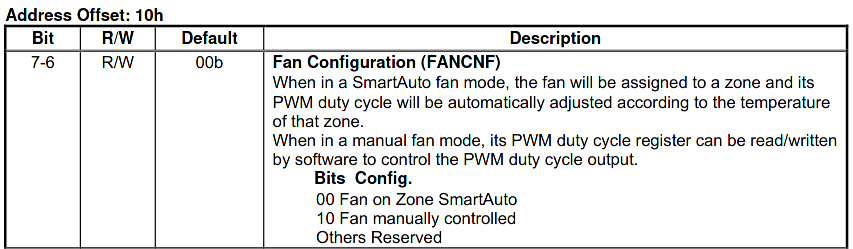
My question is: How do I get from that info (offset: 10h, bit: 7-6) to something I can actually locate in the output of
ec-probe dumpand write to withec-probe write?I'm looking forward to hearing from anyone.
@webloft commented on GitHub (Mar 12, 2021):
The address offset in this documentation may be not the same offset you get via software.
If so you would need to set the bits 7-6 of a single byte which means other bits may be necessary to keep.
So if the register value is 0x3B for example and you set bits 7-6 to 10 you'll get 0xBB
and would write that as (offset 10h = 0x10)
ec-probe write 0x10 BB
@k8ieone commented on GitHub (Mar 22, 2021):
Hi and thanks for your response.
I just tried
ec-probe write 0x10 BB, but I got this error:I also tried writing to different registers, but it looks like I can't write
BBanywhere.@webloft commented on GitHub (Mar 23, 2021):
Then you need to write
ec-probe write 0x10 0xBB
@k8ieone commented on GitHub (Mar 23, 2021):
Indeed, I do. Sorry, I was half asleep when I was trying this.
Now, I found that the default value of
0x10is00. So from what I understand, to change bits7and6to1and0, I have to write40(or80if you were counting from 0), right?EDIT: The docs do count from 0, so I assume you did too.
@webloft commented on GitHub (Mar 23, 2021):
7-6 looks like the common bit notation (starting right with position 0)
position 7 = 1
position 6 = 0
So the correct value should be 0x80.
@github-actions[bot] commented on GitHub (Sep 21, 2021):
This issue is stale because it has been open more than 180 days with no activity. If nobody comments within 7 days, this issue will be closed