[GH-ISSUE #125] MalwareBytes detects Trojan.Script.Python on a temp file after compiling a script #119

Closed
opened 2026-02-26 12:20:33 +03:00 by kerem · 2 comments
Owner

Originally created by @jb2kewl on GitHub (Oct 6, 2020).
Original GitHub issue: https://github.com/brentvollebregt/auto-py-to-exe/issues/125

I compiled a fairly simple aws script to send a sms message.. Later malware bytes picked up a temp file from this auto-py-to-exe and said it had a trojan in it.
after compiling the below script, a full machine scan picked up this file as having a trojan in it... (secrets.py just has the secret variables for this script)
(.venv) PS C:\Dev_Python\aws\sendsms> python --version
Python 3.8.5
Temp file detected with Trojan: c:\users\jrbri\AppData\Local\Temp\tmpqy3n6kg4\build\send_sms\RUN.EXE.YCOYM337

File send_sms.py:
import boto3
import secret
import sys
import re
import argparse
import os.path
from os import path
sDescText = """


Sends a sms message to a specific phone number:
Example usage:
send_sms.exe +17195551212 "Your Message"


"""

this is a pointer to the module object instance itself.

this = sys.modules[name]

parser = argparse.ArgumentParser(sDescText)
parser.add_argument("number", help="Enter the phone number here. Example: +17195551212")
parser.add_argument("message", help='Enter your SMS message in double quotes. Example: "Hello World"')
args = parser.parse_args()

if args.number != secret.aws_example_number:
sys.exit("Invalid Phone Number!")

print(args.number,":", args.message)

Create a SNS client

client = boto3.client(
"sns",
aws_access_key_id=secret.aws_key_id,
aws_secret_access_key=secret.aws_key_val,
region_name=secret.aws_region
)

Send your sms message.

client.publish(
PhoneNumber=args.number,
Message=args.message
)

requirements.txt
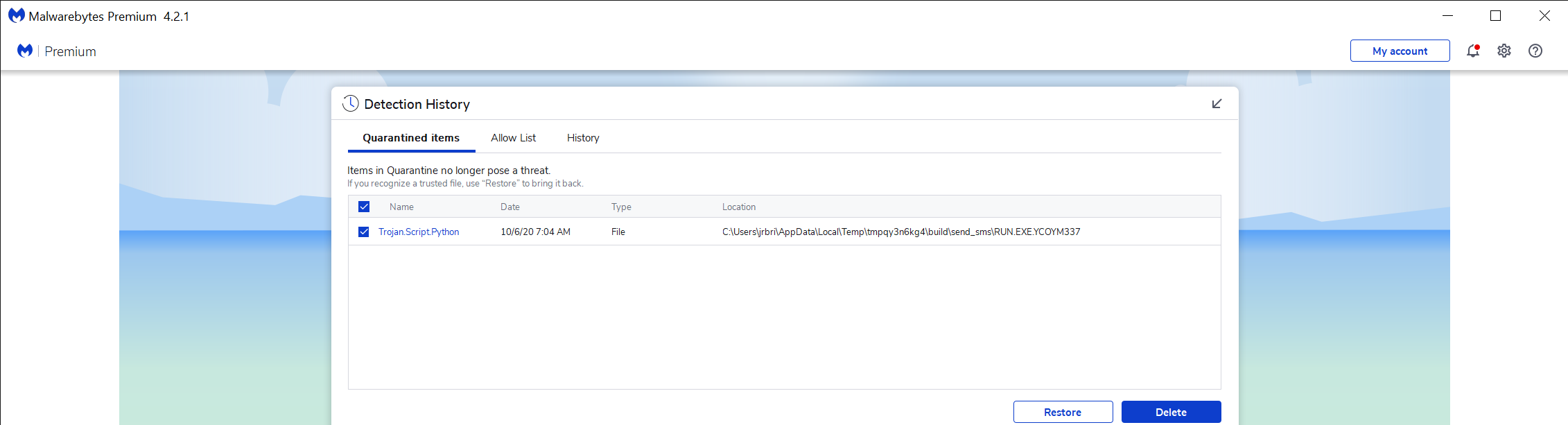
Malwarebytes Premium  4 2 1 10_6_2020 7_12_04 AM
send_sms - Copy.txt

Originally created by @jb2kewl on GitHub (Oct 6, 2020). Original GitHub issue: https://github.com/brentvollebregt/auto-py-to-exe/issues/125 I compiled a fairly simple aws script to send a sms message.. Later malware bytes picked up a temp file from this auto-py-to-exe and said it had a trojan in it. after compiling the below script, a full machine scan picked up this file as having a trojan in it... (secrets.py just has the secret variables for this script) (.venv) PS C:\Dev_Python\aws\sendsms> python --version Python 3.8.5 Temp file detected with Trojan: c:\users\jrbri\AppData\Local\Temp\tmpqy3n6kg4\build\send_sms\RUN.EXE.YCOYM337 File send_sms.py: import boto3 import secret import sys import re import argparse import os.path from os import path sDescText = """ ******************************************************************************* Sends a sms message to a specific phone number: Example usage: send_sms.exe +17195551212 "Your Message" ******************************************************************************* """ # this is a pointer to the module object instance itself. this = sys.modules[__name__] parser = argparse.ArgumentParser(sDescText) parser.add_argument("number", help="Enter the phone number here. Example: +17195551212") parser.add_argument("message", help='Enter your SMS message in double quotes. Example: "Hello World"') args = parser.parse_args() if args.number != secret.aws_example_number: sys.exit("Invalid Phone Number!") print(args.number,":", args.message) # Create a SNS client client = boto3.client( "sns", aws_access_key_id=secret.aws_key_id, aws_secret_access_key=secret.aws_key_val, region_name=secret.aws_region ) # Send your sms message. client.publish( PhoneNumber=args.number, Message=args.message ) [requirements.txt](https://github.com/brentvollebregt/auto-py-to-exe/files/5334170/requirements.txt) ![Malwarebytes Premium 4 2 1 10_6_2020 7_12_04 AM](https://user-images.githubusercontent.com/8051826/95208778-ccfc8980-07a6-11eb-9f9f-3dc7af3476cc.png) [send_sms - Copy.txt](https://github.com/brentvollebregt/auto-py-to-exe/files/5334175/send_sms.-.Copy.txt)
kerem closed this issue 2026-02-26 12:20:33 +03:00
Author
Owner

@brentvollebregt commented on GitHub (Oct 7, 2020):

Have you read brentvollebregt/auto-py-to-exe#122?

I have seen this pop up a lot more recently, for those reading this, you have a few options:

  • Tell your antivirus that these files are fine
  • Switch to a different and more accurate anti-virus
  • Notify your antivirus vendor about the false positive

This is assuming you haven't tried to package something malicious. If you have tried to package something malicious, there is no reason you should be complaining about this; the antivirus has done its job.

<!-- gh-comment-id:704701669 --> @brentvollebregt commented on GitHub (Oct 7, 2020): Have you read brentvollebregt/auto-py-to-exe#122? > I have seen this pop up a lot more recently, for those reading this, you have a few options: > > - Tell your antivirus that these files are fine > - Switch to a different and more accurate anti-virus > - Notify your antivirus vendor about the false positive > > This is assuming you haven't tried to package something malicious. If you have tried to package something malicious, there is no reason you should be complaining about this; the antivirus has done its job.
Author
Owner

@brentvollebregt commented on GitHub (Jan 19, 2021):

Closing due to no activity in more than three months and no more information provided about the issue.

<!-- gh-comment-id:763054710 --> @brentvollebregt commented on GitHub (Jan 19, 2021): Closing due to no activity in more than three months and no more information provided about the issue.
Sign in to join this conversation.
No milestone
No project
No assignees
1 participant
Notifications
Due date
The due date is invalid or out of range. Please use the format "yyyy-mm-dd".

No due date set.

Dependencies

No dependencies set.

Reference
starred/auto-py-to-exe#119
No description provided.